This month, global competition for satellite internet has intensified amid regulatory and geopolitical tensions. As Starlink continues its expansion in Africa by partnering with local telecom operators, it faces regulatory blockades in India for security reasons and growing competition from Chinese operator SpaceSail, which is accelerating its deployment on the African continent. In this context, SpaceX has warned the European Union (EU) against a spectrum reservation proposal, which according to the company could harm connectivity in Ukraine.
On the industrial front, institutional Europe has consolidated its strategic programs. The European Space Agency (ESA) has awarded major contracts for Earth observation satellites to Thales Alenia Space (Sentinel-1) and Airbus (Aeolus-2). Space and defense cooperation has been strengthened between France and Italy. Furthermore, Europe is securing a leading role in the American lunar program Artemis, with the designation of ESA Italian astronaut Luca Parmitano as pilot for the Artemis III mission. European NewSpace has, however, suffered a setback with the cancellation of the inaugural launch of German micro-launcher Spectrum by Isar Aerospace.
Finally, a underlying trend is confirmed: forecasts of the satellite market for the next decade indicate an increasing share of spending allocated to military and dual-use systems, illustrating the militarization of space.
The battle for global connectivity intensifies, between expansion and blockades
Competition for the satellite internet market has intensified this month, illustrating tensions between commercial expansion, digital sovereignty and national security imperatives.
In Africa, Starlink's strategy is evolving towards partnerships, contrasting with more conflictual approaches observed elsewhere. Several major African telecommunications operators, including MTN, Airtel, Orange and Vodafone, now view constellations as a complement rather than a threat. They are partnering with LEO (low Earth orbit) providers such as Starlink, Eutelsat OneWeb and the future Kuiper project to extend coverage to rural areas and optimize costs (TechCabal, 26/06/2026). Starlink now operates officially in 27 African countries and had 91,991 subscribers in Nigeria in the last quarter of 2025. This dynamic of cooperation does not, however, erase sovereignty concerns. Namibia has once again rejected Starlink's license application for non-compliance with local ownership rules, while security concerns are emerging regarding the potential use of the service by insurgent groups in the Sahel (Mail & Guardian, 10/06/2026).
This American expansion in Africa is now directly challenged by China. Chinese operator SpaceSail is accelerating its deployment on the continent, marking a new stage in Beijing's strategy which, after terrestrial infrastructure, is now aiming to establish its influence from space. This offensive is perceived as a technological and geopolitical battle aimed at offering an alternative to Starlink (RFI France, 27/06/2026).
In India, Starlink's deployment is stalled. India's Department of Telecommunications (DoT) has published a draft of rules for administrative spectrum allocation that explicitly excludes non-geostationary orbit (NGSO) constellation operators such as Starlink, Eutelsat OneWeb or the local Jio Satellite Communications project (MediaNama, 23/06/2026). This decision, which follows security concerns already reported earlier in the month, effectively delays the commercial launch of satellite broadband in the country, leaving NGSO actors in regulatory uncertainty despite their existing licenses (MediaNama, 10/06/2026).
These regulatory tensions are also evident in Europe. SpaceX has publicly criticized a European Union proposal aimed at reserving part of the spectrum for European operators. According to the company, this protectionist measure risks compromising satellite connectivity in Ukraine, an argument with significant political weight in the current context (Financial Times, 18/06/2026).
Institutional Europe consolidates its industrial and strategic positions
Facing this intensified global competition, Europe has made important gains this month, strengthening its industrial capabilities and strategic positioning through the ESA and bilateral agreements.
Important contracts have been signed for Earth observation programs. Thales Alenia Space (Thales/Leonardo joint venture) has won a major contract with the ESA for the construction of the next two satellites of the Sentinel-1 constellation, ensuring a key radar capability of the Copernicus program (Il Sole 24 Ore, 10/06/2026). For its part, Airbus has been awarded by the ESA the design and construction of the Aeolus-2 satellite, dedicated to wind measurement, confirming its leading role in this segment (Cinco Días, 02/07/2026). These observation programs demonstrate their relevance, with Copernicus data having been widely mobilized this month to document heat waves in Europe — with ground temperatures approaching 50°C — and to alert to the increased probability of a powerful El Niño episode (ANSA, 25/06/2026 ; Le Figaro, 10/06/2026).
On the strategic front, bilateral cooperation has been strengthened. The Antibes summit between Emmanuel Macron and Giorgia Meloni resulted in a five-year roadmap (2026-2031), including the consolidation of the space industry through the Bromo project and collaboration on sovereign technologies (Il Fatto Quotidiano, 24/06/2026).
The strongest signal is perhaps Europe's participation in the American lunar program. Italian ESA astronaut Luca Parmitano has been designated by the National Aeronautics and Space Administration (NASA) as pilot of the Artemis III mission, scheduled for 2027. This mission is a crucial step towards humanity's return to the Moon (Governo Italiano, 01/07/2026 ; FAZ - Aktuell, 12/06/2026). He will train to pilot complex docking maneuvers in Earth orbit with the Orion capsule and spacecraft from Blue Origin and SpaceX (Il Fatto Quotidiano, 15/06/2026). The political staging of this appointment, with the presentation of the Italian flag by Prime Minister Giorgia Meloni, underscores the importance of this cooperation for Italy and Europe, which thus ensure themselves a leading role in future crewed missions.
NewSpace: between market consolidation and setbacks for European launchers
The NewSpace sector is experiencing a phase of maturation, characterized by consolidation movements and technical challenges for new entrants.
The project to acquire Iridium, the historic satellite communications operator, by Rocket Lab perfectly illustrates this trend (Breaking Defense, 29/06/2026). This operation of strategic vertical integration would allow Rocket Lab to control the entire value chain, from satellite manufacturing to their launch and operation, in a quest for efficiency and cost reduction.
However, the development of new launch capabilities remains a major challenge, particularly in Europe. German start-up Isar Aerospace has had to cancel the inaugural launch of its Spectrum rocket twice, designed for small satellites, due to technical irregularities (FAZ - Aktuell, 15/06/2026). This setback delays Germany's and Europe's ambitions to have private and sovereign access to space for small payloads.
This difficulty contrasts with SpaceX's dominance, although the company itself experienced a "blow" this month when NASA awarded a Mars mission to a competitor (Cinco Días, 18/06/2026). Meanwhile, the battle for sovereign access to space continues, with the Ariane 6 European program seeking to position itself against SpaceX, and would receive support for this from Jeff Bezos (Financial Times, 21/06/2026).
Finally, the underlying market trend confirms a major strategic shift. A forward-looking analysis of the global satellite market for the decade 2026-2036 anticipates a growing and significant share of spending allocated to military and dual-use systems. This evolution, against the backdrop of global geopolitical tensions, outlines a future where the boundaries between civilian and military uses of space will continue to blur (Airforce Technology, 01/07/2026).
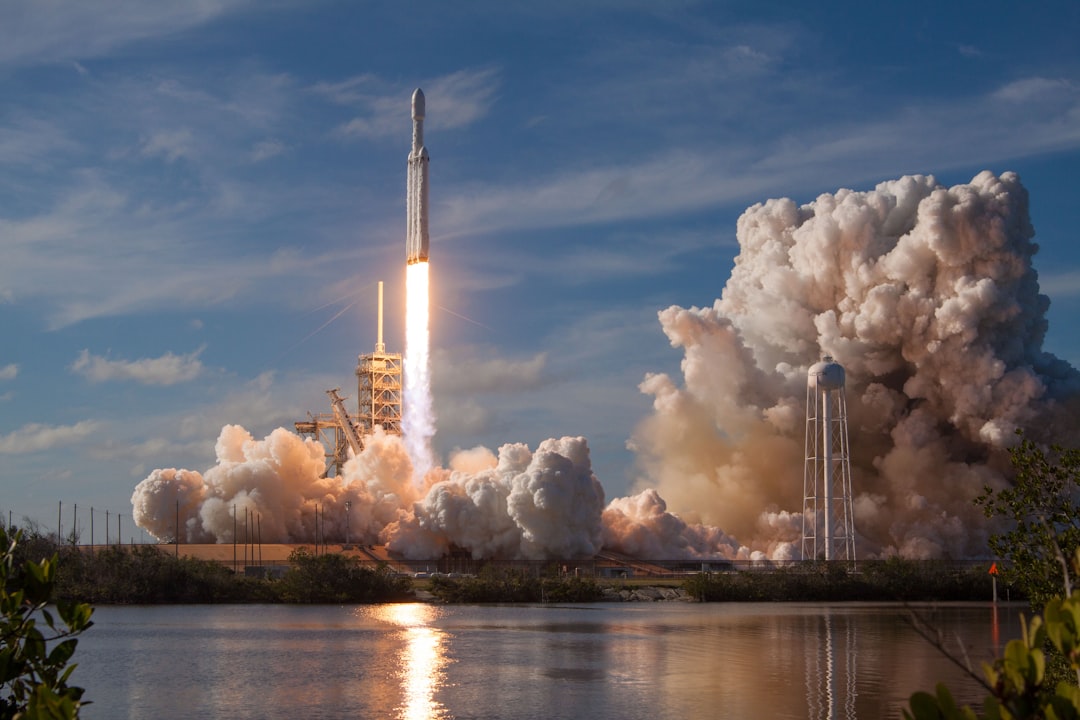
Photo: SpaceX / Unsplash
Get the Space briefing by email
Monthly intelligence on space, curated with AI and reviewed by senior analysts. Available in English, French and Italian.
Subscribe for free